http://www.theartisanstore.com.au/event/thomas-coin-carnival-artist-week/
Category: General posts
-

Medieval coins hand made in to coin rings
These coins are so different from any other coins I use for my hand made coin rings. They are replicas of medieval coins made in brass. Very good replicas with a lot of detail. I was asked once if I can make a coin ring from an old medieval silver thaler. I looked at the coin and it was very worn and after evaluating I think it was still worth over $500 USD. I denied as I was not so sure if this was a good idea. It turned out the coin was a modern reproduction made in silver but the owner bought it as a real medieval coin. Bummer. Well, I contacted this potential client two months later when we were getting ready to go to Medieval Festival in Balingup WA to tell him that I just made few medieval coin rings from very crisp medieval brass coins for the festival. He bought one ring and we sold few more at the festival. Here are few photos of my work progress hand making few of those medieval coin rings. I still have few coins left so feel free to order one if you would like to wear something very, very unique on your finger.


History of medieval coins
Medieval Europe didn’t need money. Or better say precious money. When you have a local trading and you agricultural farm produce all you need, money is not necessary to buy things that don’t exist or you don’t need them. In the XIII century, this changed. The need for a high value coin was the natural consequence of the trade that flourished. In Italy, Venice and Florence minted for the first time in centuries a gold coin, the ducato or florino. But gold was still a very rare metal. If you buy a ship, you will need either some hundred of thousands of small silver coins or some
hundreds of gold. But if you go to the market to buy an ox? In the XIV century, the first heavy coins appeared, with a weight of 5-10 gr, for example the half Guldengroschen of Archduke Sigismund of Tirol. With the weight of 15 gr, it was ideal for transaction with medium value. Also in England or France, similar coin appeared.Because the mints needed silver, they were created near mines. In 1518, in a silver mine from Bohemia, now Czech Republic, a new coin was minted.
The mine, one of the few that produced silver in Europe in that time, was named St. Joachimstaler or “The valley of St. Joachim”, with taler meaning valley. The coin engraver from the mint that functioned around the mine decided to use the large quantity of silver to produce a large coin of silver that proved to be succesful in Germany. The coin, with around 26-28 gr, was named by the population the coin from St. Joachim’s Vallery and later simplified as Joachimsthaler or simply thaler.
In Germany, soon after every city and ruler started minting coins similar to the thaler. All of them, in similar size, were named thaler. In Scandinavia, the thaler was minted by the Swedish kings, who named it daler. In 1570 this coin reached Netherlands. The coin produced here depicted on one side a lion so it was named Lowenthaler or
Thaler with the lion. It was such a popular coin that circulated in all of Eastern Europe.In Spain, the coin had a value of 8 real. It was nicknamed talar or tolar. When Spain controlled the Americas, this coin was used also
there. Because of the pronunciation, in America it became Dolar. In 1780-1790’s, when the US coin was adopted, the most popular coin of
the region was favored instead of the British pound, the official currency until 1776. More, from the symbol of a Spanish thaler, marked
with the sign 8 R the symbol $ appeared as a form of writing the 8.If you made this far reading about medieval coins here is an interesting video on youtube:
-
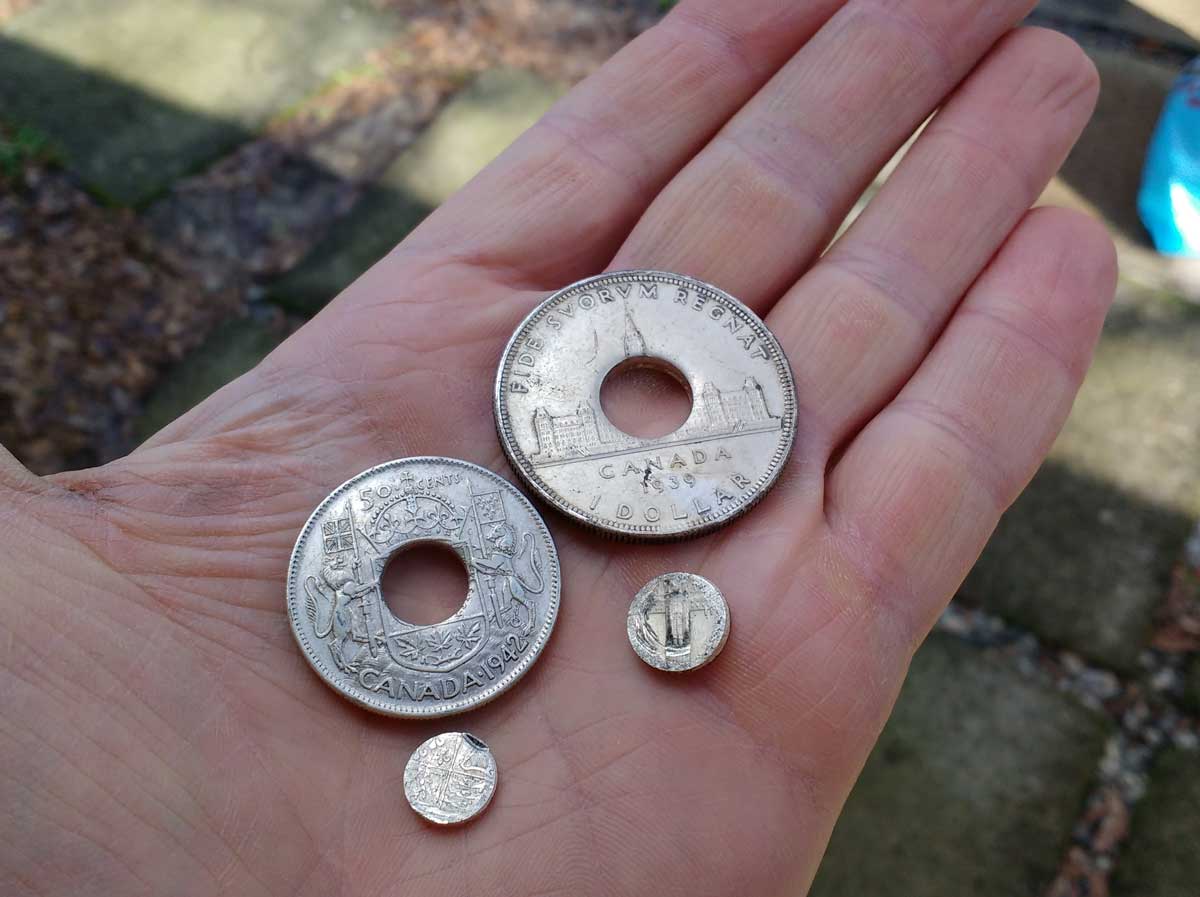
1939 Canadian silver dollar coin ring and 1942 Canadian silver 50 cent coin ring
This set of coin rings is for a very special couple in Canada. Canadian silver coins can be ringed into very cool looking coin rings. It was fun crafting both of them. 1939 Canadian silver dollar is around 35mm in diameter and there are 4 different designs. 1942 Canadian 50 cent coin was around 29mm in diameter.
1939 Canadian silver dollar history
This coin, the second commemorative silver dollar struck in Canada, was minted to celebrate the visit of King George VI and Queen Elizabeth in 1939. The reverse of the coin depicts the Parliament buildings in Ottawa. The Latin legend FIDE SUORUM REGNAT (He reigns by the faith of his people) appears above. The design was created by sculptor Emmanuel Hahn, whose initials, EH, appeared on the original model. This was not an unusual feature since Hahn’s initials appear on silver dollars minted prior to 1939. His initial H, can also be seen on his well-known designs for Canada’s ten-cent and twenty-five cent pieces – the Bluenose and the caribou head – for the series minted since 1937.
The Government of the day, however, seemed to disapprove of the personal touch on this coin and the initials were removed from the final version without consultation. Hahn made strong representations to the Mint, the Minister of Finance and the Prime Minister. The only explanation that he received came from W. C. Clark, Deputy Minister of Finance, who informed Hahn that the decision to omit his initials had been made by the Governor in Council. The obverse of the coin bears the portrait of George VI facing left, surrounded by his Latin titles. The coin contains 80% silver.
1942 Canadian silver 50 cent history
The fifty-cent piece is the common name of the Canadian coin worth 50 cents. The coin’s reverse depicts the coat of arms of Canada. At the opening ceremonies for the Ottawa branch of the Royal Mint, held on January 2, 1908, Governor General Earl Grey struck the Dominion of Canada’s first domestically produced coin. It was a silver fifty-cent piece bearing the effigy of King Edward VII.
Mintage
- 50 cents 1942 – Narrow Date : 1 974 165
- 50 cents 1942 – Wide Date : Included
Specifications – 50 cents 1942 – Narrow Date
- Alloy: 80% silver, 20% copper
- Weight: 11.66 grams
- Diameter : 29.72 mm, thickness 2 mm
- Engraver: Obverse: T. H. Paget, Reverse: G. E. Kruger- Gray
- Designer: Obverse: T. H. Paget, Reverse: G. E. Kruger- Gray
- Edge: Reeded
- Magnetism: Nonmagnetic
- Die axis: ↑↑


