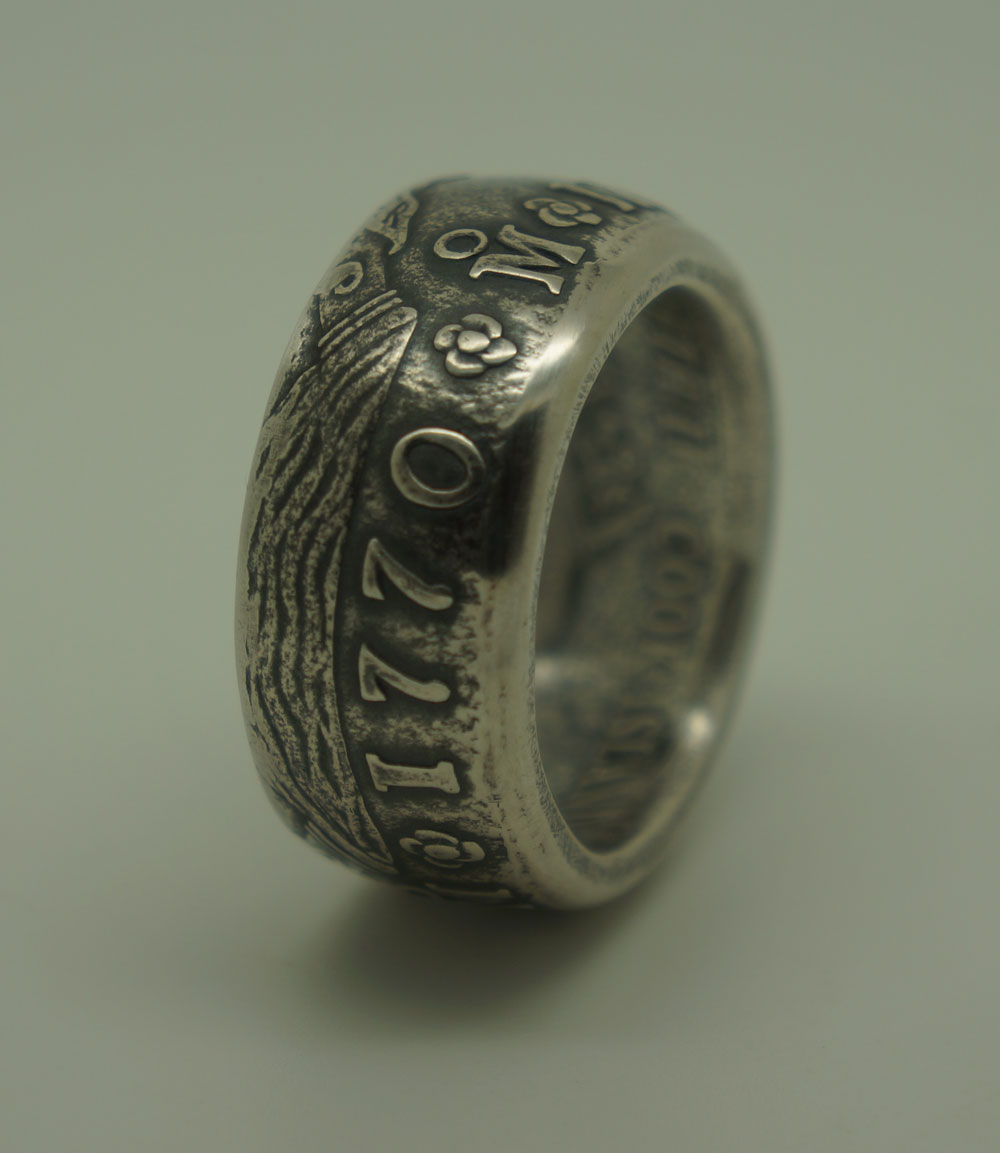
Early Spanish Colonial coins
PILLAR DOLLAR
This is a Spanish 8 reale piece that was the most popular in the American Colonies until 1857. Known as ;Pieces of Eight because of how much the coin could get cut up into pieces to give change.
The Pillar Dollar was also minted in 4,2, 1 reales. Struck mostly in Mexico Santiago, which was very rare. The obverse has two globes depicting the Old New World. On the reverse the Pillars of Hercules the gates of the New World. Here are some examples of the original coins from 1700’s.


History
Spanish colonial coinage in the English colonies
The importance of Spanish money in the colonies cannot be overstated. It has been estimated that half of the coins in colonial America were Spanish reales. They were used not only as coinage but also treated as a commodity, as one would use silver or gold bars. In 1645 Virginia made the Spanish real the standard currency. In fact, the first coinage authorized by an English Royal patent for the colonies, the American Plantations token, minted at the Tower of London, stated its value on the obverse of the coin not in English currency but as 1/24th of a Spanish real.
As discussed in the introduction to Massachusetts silver, in 1711, the English ship H.M.S. Feversham requesitioned £569 12s5d in money from the British Treasury Office in New York City before sailing to assist a British fleet for an attack on Quebec. On its way north the ship sank off the coast of Nova Scotia. In 1984 the ship was found and salvaged. Among the items on board were £33 13s in coins, presumably the portion of the allocation obtained in New York. This hoard contained 8 English coins, 22 Dutch coins, 126 pieces of Massachusetts silver, 5 coins from Spain and 504 New World Spanish coins. There is no doubt that even during the period when the Dutch were importing their “Lion Dollars” into New York and most successful local silver coins in the colonies, the Massachusetts Pine Tree series, were still in circulation, the most abundant coinage by far was the silver from colonial Spain.
In addition to coin hoards there is an abundance of recorded information on Spanish colonial coinage in the English colonies. In 1750 Massachusetts paper currency was redeemed in Spanish silver coin, including many pistareens that had arrived the previous year from England on the ship Mermaid. The ship had delivered 207 chests of milled Spanish pistareens and eight chests of pillar two reales, which the invoice called “pillar pistereens,” along with many British coppers in payment for the colonists’ help against the French during the Louisbourg Expedition in the French and Indian Wars [see, John Sallay in The Colonial Newsletter, 15 (1976) 519-531]. Maryland colonial paper currency issues from 1767-80 were not only backed by Spanish milled coinage but were also denominated in Spanish dollars rather than English pounds, with the $1 and $2 notes of the emissions of Jan. 1, 1767; March 1, 1770, and April 10, 1774, depicting the Spanish milled dollar on the obverse of the note (see our March 1770 examples). In fact, most paper currency issues from the mid 1770’s, including those of the Continental Congress, were made equivalent to and denominated in Spanish dollars.
As noted above, through the mid Eighteenth century cob coinage continued to be produced throughout the Viceroyalty of Peru, with the final cobs being produced at the Potosí mint in Bolivia in 1773. During this era the English colonists called all cob coinage “Peruvians” and treated them as inferior products. Rather, the colonists avidly sought the “milled” or “pillar dollar” as they called the new eight reales. They referred to smaller denomination coins as “bits” thus the one, two and four reales were the one, two and four bit coins, with the half real called a half bit or a “picayune.” Often the term “bit” was also a graphic description, for the eight reales, or smaller denomination coins, would actually be sawed into halves, quarters or eighths, into actual bits, to make small change. For an interesting discussion of Spanish coins and bits found in Virginia see the Kays article cited in the bibliography.
Spanish coinage, both cobs and milled products, were treated in a similar fashion throughout the British West Indies. Several islands such as Jamaica, Barbados, Greneda and Montserrat both cut and counterstamped these coins with local marks as a way of producing a regional coinage. Through trade, some of these island counterstamped Spanish pieces made their way into circulation in colonial America.
Spanish dollars were made legal tender in the United States by an Act of February 9, 1793, and were not demonetized until February 21, 1857. Testaments to the importance of these coins continue in that “two bits,” “pieces of eight” and “picayune” have become part of the American vocabulary. Also, it is interesting to observe that when the New York Stock Exchange opened in 1792 rates were reported in terms of New York shillings which were valued at eight to the Spanish milled dollar, hence changes were reported in eighths. Amazingly, over two hundred years after adoption of the decimal system, stock and security price variations are still reported in eighths!
Here is my take on this coin … well current commemorative version of this interesting coin:


