Category: Work

  • 1939 Canadian silver dollar coin ring and 1942 Canadian silver 50 cent coin ring

    1939 Canadian silver dollar coin ring and 1942 Canadian silver 50 cent coin ring

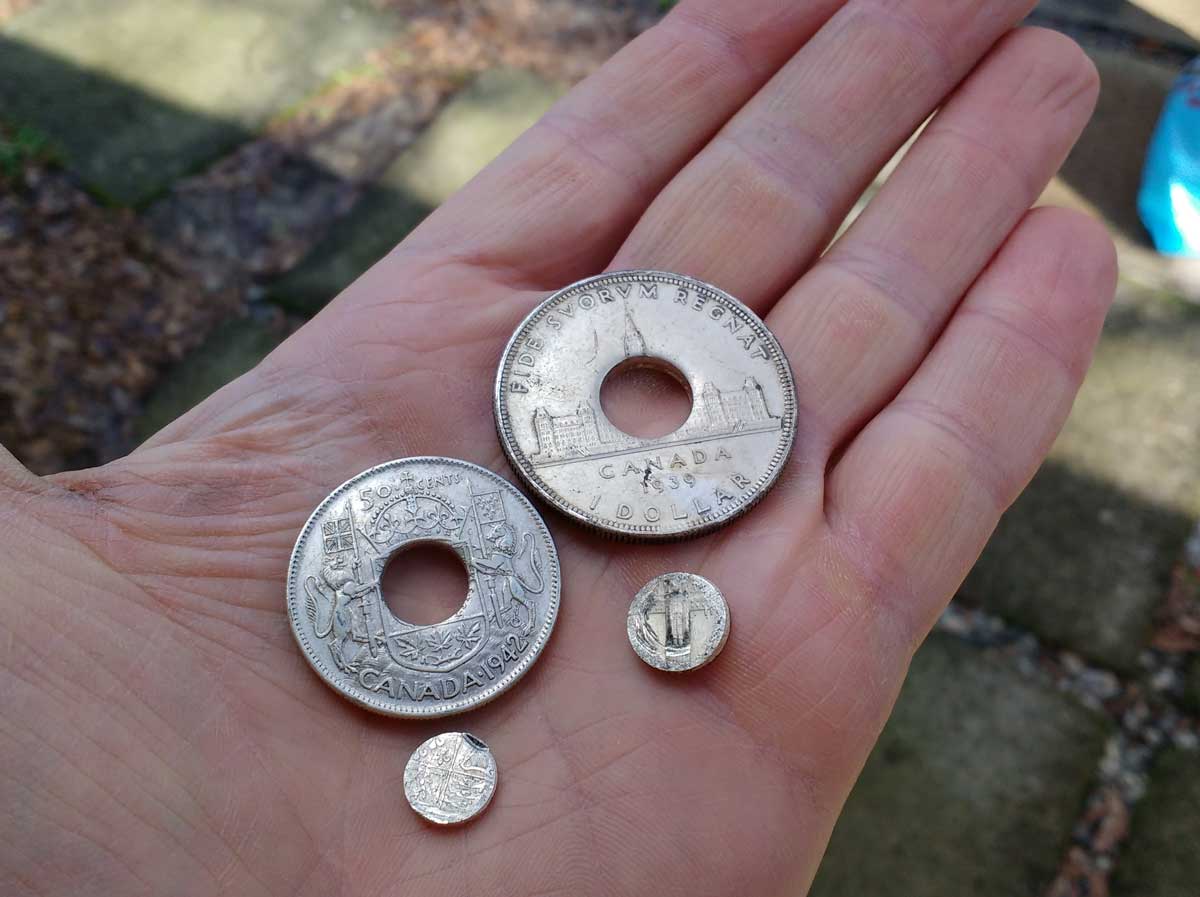
    This set of coin rings is for a very special couple in Canada.  Canadian silver coins can be ringed into very cool looking coin rings.  It was fun crafting both of them.  1939 Canadian silver dollar is around 35mm in diameter and there are 4 different designs.  1942 Canadian 50 cent coin was around 29mm in diameter.

    1939 Canadian silver dollar history

    This coin, the second commemorative silver dollar struck in Canada, was minted to celebrate the visit of King George VI and Queen Elizabeth in 1939. The reverse of the coin depicts the Parliament buildings in Ottawa. The Latin legend FIDE SUORUM REGNAT (He reigns by the faith of his people) appears above. The design was created by sculptor Emmanuel Hahn, whose initials, EH, appeared on the original model. This was not an unusual feature since Hahn’s initials appear on silver dollars minted prior to 1939. His initial H, can also be seen on his well-known designs for Canada’s ten-cent and twenty-five cent pieces – the Bluenose and the caribou head – for the series minted since 1937.

    The Government of the day, however, seemed to disapprove of the personal touch on this coin and the initials were removed from the final version without consultation. Hahn made strong representations to the Mint, the Minister of Finance and the Prime Minister. The only explanation that he received came from W. C. Clark, Deputy Minister of Finance, who informed Hahn that the decision to omit his initials had been made by the Governor in Council. The obverse of the coin bears the portrait of George VI facing left, surrounded by his Latin titles. The coin contains 80% silver.

    1942 Canadian silver 50 cent history

    The fifty-cent piece is the common name of the Canadian coin worth 50 cents. The coin’s reverse depicts the coat of arms of Canada. At the opening ceremonies for the Ottawa branch of the Royal Mint, held on January 2, 1908, Governor General Earl Grey struck the Dominion of Canada’s first domestically produced coin. It was a silver fifty-cent piece bearing the effigy of King Edward VII.

    Mintage

    • 50 cents 1942 – Narrow Date : 1 974 165
    • 50 cents 1942 – Wide Date : Included

    Specifications – 50 cents 1942 – Narrow Date

    • Alloy: 80% silver, 20% copper
    • Weight: 11.66 grams
    • Diameter : 29.72 mm, thickness 2 mm
    • Engraver: Obverse: T. H. Paget, Reverse: G. E. Kruger- Gray
    • Designer: Obverse: T. H. Paget, Reverse: G. E. Kruger- Gray
    • Edge: Reeded
    • Magnetism: Nonmagnetic
    • Die axis: ↑↑
  • AUSTRALIA 1988 SILVER HOLEY DOLLAR and DUMP coin ring

    AUSTRALIA 1988 SILVER HOLEY DOLLAR and DUMP coin ring

    AUSTRALIA 1988 SILVER HOLEY DOLLAR and DUMP

    Obverse: Maklouf portrait of Elizabeth II to right; Reverse: Wawalag Sisters and The Rainbow Serpent

    The first of the three silver coin sets issued by the Perth Mint commemorating the Holey Dollar and Dump.

    The Perth Mint released a pair of silver coins in 1988 to celebrate Australia’s Bicentennial year, the designs were based on the famous Holey Dollar and Dump.
    Two further pairs of silver coins were released in 1989 and 1990 to form a set of 3 pairs of Holey Dollars & Dumps, a full colour book / album was also released to store the coins in. Due to the innovative designs, low mintage figures and informative colour booklets released with each coin, it was a hugely popular series.

    Description:
    Mintage: 100,000
    Dollar Composition: 1 oz .999 Silver; 31.935 grams
    Dump Composition: 1/4 oz .999 Silver; 7.984 grams

    A card booklet containing a commemorative silver Holey Dollar a dump featuring the Arnhem Land Aboriginal Dreamtime story of the Wawalag (or Wagilag)
    sisters from which the reverse depictions of the snake (on the holey dollar) and the two sisters (on the dump) are drawn

    The coins are encapsulated and housed in a special presentation wallet
    1813 Holey Dollar and Dump Australia’s first silver coins

    In the early 1800s, the Governor of NSW bought a house. He paid for it with 200 gallons of rum. Strange, you think? But no, this wasn’t at all unusual.
    Even though New South Wales had moved on from being a penal colony and was fast developing into a well established and a vibrant society, there was still no bank – and no local currency.

    The laws of economics being what they are, something else had to take its place as a medium of exchange, and the most commonly used alternative was liquor. Rum was selling at more than twenty times its nominal value, and its popularity as a negotiating medium was embraced by all sections of the community – including Governor Lachlan Macquarie himself.

    It was, though, a clearly unsustainable situation, and in 1812, the Governor set in motion a plan to resolve the colony’s currency crisis by importing 40,000 Spanish Silver Dollars.

    To stop the coins disappearing into traders’ pockets, he had them punched-out and re-stamped, making them useless outside Australia. In the process, each dollar became two coins: the large donut-like outer ring, and the punched-out inner disc.

    The newly created ring was re-stamped with a value of five shillings, the year 1813, and had the issuing authority of New South Wales around the inner circumference. This became the 1813 Holey Dollar.

    The circular inner was re-stamped with a crown, the year 1813, the issuing authority and the value of fifteen pence. This became The Colonial Dump.

    The coins provided a vital short-term solution to the colony’s currency crisis and remained in official circulation for 16 years, before being withdrawn in 1829 when the Sterling standard was re-imposed.

    In all, 39,910 Holey Dollars and 39,910 Colonial Dumps were released. A total of 27,161 Holey Dollars and 10,103 Dumps were shipped to London to be melted down and sold off as bullion silver. Of those that didn’t go to the smelter, there are now only some 300 known surviving Holey Dollars (around 200 of them in private hands) and about 800 Dumps.

    Better than a keg of rum any day.

    Available for sale in my online shop.

    For more information on the history of the Australian Holey Dollar visit the link below:

    CoinWorks


  • 1897 British Silver Crown coin ring

    1897 British Silver Crown coin ring

    The British crown, the successor to the English crown and the Scottish dollar, came into being with the Union of the kingdoms of England and Scotland in 1707. As with the English coin, its value was five shillings.   Always a heavy silver coin weighing about one ounce, during the 19th and 20th centuries the Crown declined from being a real means of exchange to being a coin rarely spent and minted for commemorative purposes only. In that format it has continued to be minted, even following decimalisation of the British currency in 1971. However, as the result of inflation the value of the coin was revised upwards in 1990 to five pounds.

    History

    The coin’s origins lay in the English silver crown, one of many silver coins that appeared in various countries from the 16th century onwards, the most famous example perhaps being the famous Spanish pieces of eight, all of which were of a similar size and weight (approx 38mm diameter and containing approx 25 grams of fine silver) and thus interchangeable in international trade. The kingdom of England also minted gold Crowns in the 16th and 17th centuries.

    The dies for all gold and silver coins of Queen Anne and King George I were engraved by John Croker, a migrant originally from Dresden in the Duchy of Saxony.

    The British crown was always a large coin, and from the 19th century it did not circulate well. However, crowns were usually struck in a new monarch’s coronation year, true of each monarch since King George IV up until the present monarch in 1953, with the single exception of King George V.

    The Queen Victoria “Gothic” crown of 1847 (with a mintage of just 8,000 and produced to celebrate the Gothic revival) is considered by many to be the most beautiful British coin ever minted.

    The King George V “wreath” crowns struck from 1927 through 1936 (excluding 1935 when the more common “rocking horse” crown was minted to commemorate the King’s Silver Jubilee) depict a wreath on the reverse of the coin and were struck in very low numbers. Generally struck late in the year and intended to be purchased as Christmas gifts, they did not circulate well, with the rarest of all dates, 1934 (mintage just 932), now fetching several thousand pounds each. The 1927 “wreath” crowns were struck as proofs only (15,030 minted).

    With its large size, many of the later coins were primarily commemoratives. The 1951 issue was for the Festival of Britain, and was only struck in proof condition. The 1965 issue carried the image of Winston Churchill on the reverse, the first time a non-monarch or commoner was ever placed on a British coin, and marked his death. According to the Standard Catalogue of coins, 19,640,000 of this coin were minted, a very high number at the time, making them of little value today except as a mark of respect for the national war leader. Production of the Churchill Crown began on 11 October 1965, and stopped in the summer of 1966.

    The crown was worth five shillings (or 60 pre-decimal pence) until decimalisation in February 1971, and was also the basis of other denominations such as the half crown and double crown.

    The last five shilling piece was minted in 1965.

    The crown coin was nicknamed the dollar, but is not to be confused with the British trade dollar that circulated in the Orient.

    In 2014, a new world record price was achieved for a milled silver crown. The coin was issued as a pattern by engraver Thomas Simon in 1663 and nicknamed the “Reddite Crown”. This was presented to Charles II as the new crown piece but was ultimately rejected in favour of the Roettiers Brothers’ design. Auctioneers Spink & Son of London sold the coin on 27 March 2014 for £396,000 including commission.

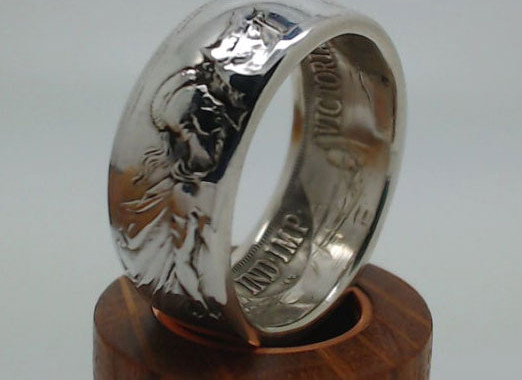
    I have quoted all of the above info from Wikipedia.  Very interesting coin with lots of history.  Ring made out of this silver crown shown in my photos below was purchased by Keith.  Thank you very much for your purchase Keith!