Unfortunately little is known about the important and captivating coin called the Continental Dollar. The denomination of the coin is unknown, but Newman has surmised the value to be a dollar. The first four emissions of Continental paper currency from May 10, 1775, through May 6, 1776, included a dollar bill, but the one dollar denomination was missing from the next six emissions and does not reappear until the last regular emission of Continental paper currency from January 14, 1779. It is thought that this Continental coin was meant to replace the paper dollar in these emissions. Also, the coin was made to be about the same size as the Spanish milled dollar and, like the Spanish coin, had an edge design. However who authorized or minted the coins is unknown.
Interestingly, there are no records of this coin in the actions of the Continental Congress, although other coinage concerns were recorded. On April 19, 1776 the Congress appointed a committee to determine the value of several foreign coins in relation to the Spanish dollar and on February 20, 1777 a congressional treasury committee recommended a mint be established, but nothing further was done on this matter. To date there is no evidence the Continental Currency coins were authorized or issued by the Continental Congress. Indeed, Robert Morris, the Superintendant of Finance during the Confederation period, appears not to have known of the Continental Dollars as he called his 1783 Nova Constellation patterns the first that were, “struck as an American Coin.” (Morris, Diary for April 2, 1783).
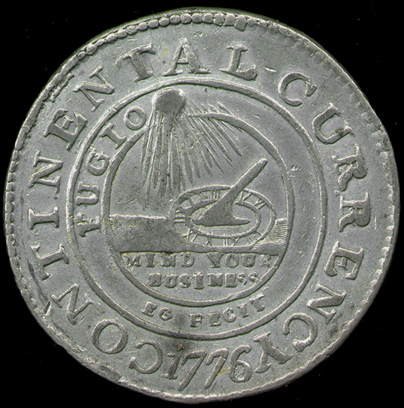
The images on the Continental Currency coin are based on the designs found on Continental Congress fractional currency from the emission of February 17, 1776, which were designed by Benjamin Franklin. In fact, Newman has published Franklin’s original drawing for the joined ring design on the reverse of the coin. One variety of the coin (shown below) includes the legend “EG FECIT”, which is Latin for “EG made this”. Newman has identified ‘EG’ as Elisha Gallaudet, who had previously engraved the design on the plates of the February 17, 1776, Continental fractional currency. His coins were struck in three metals the most common being pewter, with an estimated minting of about six thousand (of which a few hundred survive); the others, struck in brass and silver, are much rarer, with fifteen or so known examples in brass and four in silver. There are seven known die combinations made from four obverse and two reverse dies, with one obverse die (Newman 1) containing a misspelling of currency as CURENCY and another (Newman 4) having the misspelling CURRENCEY. From a close examination of the dies, Michael Hodder has demonstrated that the three metals were not used sequentially but rather were randomly minted during production. This suggests that the rare metal strikes were special presentation pieces rather than trial or pattern pieces.
The location of the mint is unknown but is thought to have been New York City. Articles referring to a Continental copper coin are found in the New York Journal of June 27, 1776, and the New York Gazette of July 1, 1776. In addition, the New York State paper currency emission of August 13, 1776, included four fractional notes as well as $2, $3, $5 and $10 bills, but like the Continental Congress emissions, did not include the $1 note. Hodder proposes two groups of dies made by different die sinkers and suggests that these two groups of coins may not have been minted in the same location. Group one includes Newman obverse dies 1 and 2 with a single reverse found in three different states listed by Newman as reverses A, B and C. Group two consists of two obverse dies, Newman 3 and 4 (with Newman obverse 5 being a recut of die 4) combined with one reverse die known as Newman D.
Obverse: [outer ring] CONTINENTAL CURRENCY 1776 [Inner ring] FUGIO EG FECIT [below sundial] MIND YOUR / BUSINESS [Sundial numerals: I, II, III, (four behind gnomon) V, VI, (space) VII, XII, X, IX, IIX] .
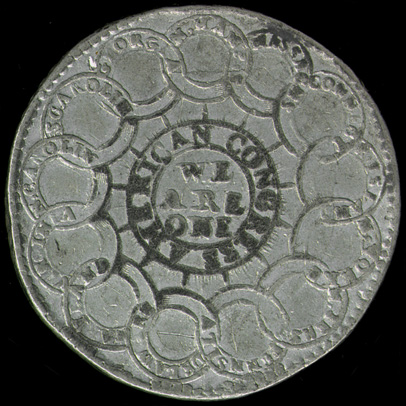
Reverse: [within ring] AMERICAN CONGRESS [in center] WE / ARE / ONE [within rings:] N. HAMPIS / MASSACHS / CONNECT / R. ISLAND / N. YORKE / N. JERS[EY] / PENNSILV / DELAWARE / MARYLAND / VIRGINIA / N. CAROLIN / S. CAROLIN / G[E]ORGIA [Brackets denote weak letters.]
Weight: 276.5 g (17.92 grams) Diameter: 40.6 mm
Comments: This coin belongs to Hodder’s group two category. Group two used different die sinkers than group one and may even be from a different mint. The obverse can easily be distinguished as die 3 by the “EG FECIT”. This is the only signature die in the series, all others are blank in that space.
The reverse, known as Newman D, is actually the second of only two reverse dies and can also be easily identified. It has a full size N in AMERICAN without a stop, while the other reverse die has a half size N with a stop below. It can also be identified by a die break that first appears as a line through the rings from Massachusetts through New Jersey and progressively lengthened to include the rings from Georgia through Delaware. Based on the growth of the die break Hodder suggests that this die combination was the first to be struck in group two, initally in pewter, then in both silver and pewter. The reverse was then combined with obverse die 4, then with obverse 3 again, then with obverse 5 and finally with obverse 3 once again (all in pewter). In this example the die break appears to extend from the bottom of the first G in Georgia, where it is very light; it becomes heavier at the final A and can be easily seen in the lower portion of the Massachusetts ring. It continues rather prominently to the final E in New Yorke and then stops inside the New Jersey ring. The following three rings contain grafitti as follows: scratch marks appear in the PA ring, while there is a B in each on the DE and MD rings. This example appears to be from an intermediate use of the die as the break has progressed more than its early state but is not as long as the late state.