Japanese 1 SEN coin history
The 1 sen coin was first minted by the Empire of Japan in 1873. Since then, new issues of the coin were introduced in 1898, 1913, 1916, 1927, 1938, 1941, and 1944. A new coin was created in 1945, but apparently never issued.
First coin
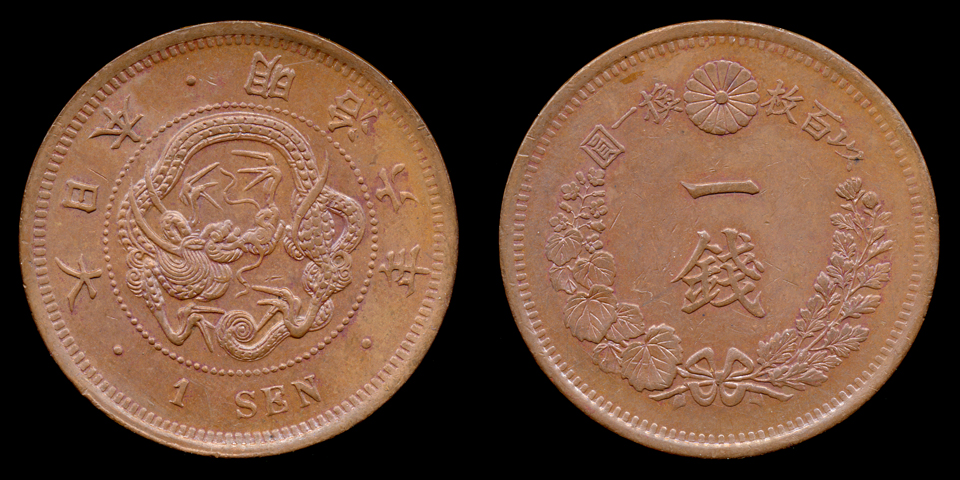
The first 1 sen coin.
During 1873, the Empire of Japan issued the first 1 sen coin along with the 1 rin, ½, and 2 sen coins. This coin was composed mainly of copper. It had a mass of 7.13 grams and a diameter of 27.9 millimeters. Displayed on its obverse was a Japanese dragon along with the value, year of minting, and issuing authority (本日大) of the coin. On its reverse, the value was displayed (as 一銭) surrounded by branches at its sides, the Imperial Seal above, and the text, “圓一換 枚百以”. The minting of these coins eventually ended in 1888.
Second coin
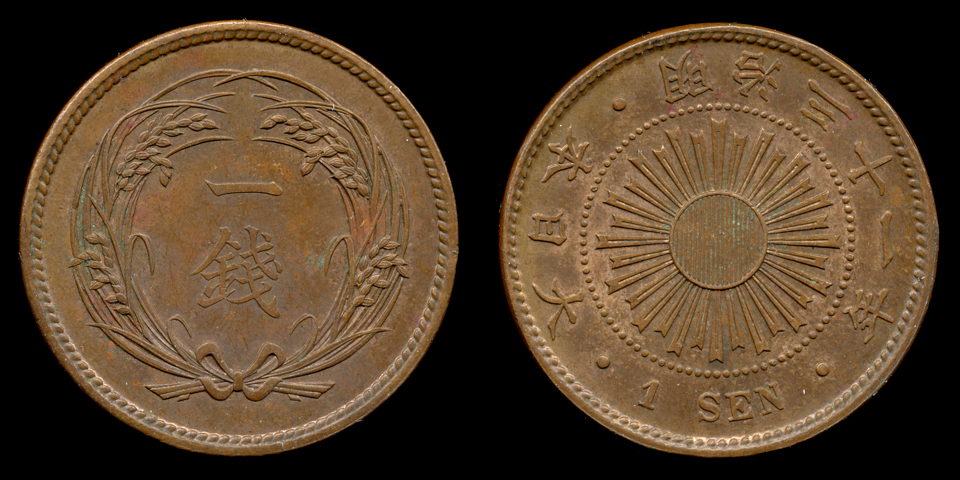
A 1 sen coin from 1898.
During 1898, after 10 years of the absence of the 1 sen coin, the Empire of Japan issued a new coin. It was mainly composed of copper, but also had a percentage of tin, officially making the coin of bronze. The coin had a mass of 7.13 g and a diameter of 27.9 millimeters, retaining the original size and weight of the original 1 sen coin. On the coin’s obverse, the sun was displayed with the value, year of minting, and the title of the issuing authority (本日大), while the reverse showed the value (as 一銭), surrounded by grains. It was minted until 1902.
In 1913, the coin was reintroduced, and remained minted until 1915, when production of the coin had officially come to an end.
Third coin
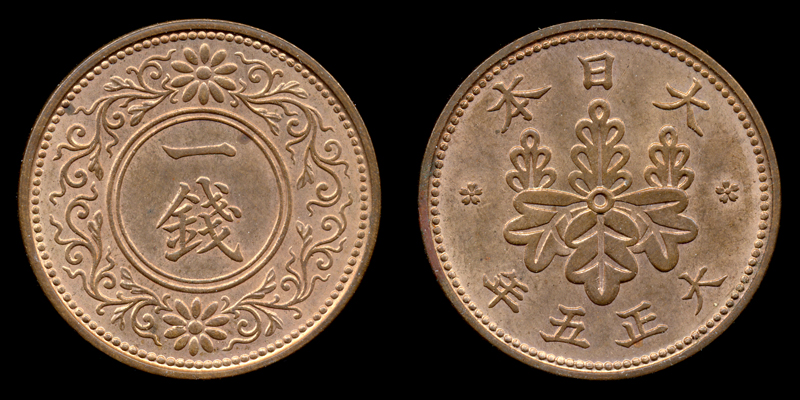
The third 1 sen coin.
In 1916, another 1 sen coin was introduced. It was composed of bronze like the previous coin. However, this coin was smaller in mass and diameter, being only 3.75 grams in mass and 23 millimeters in diameter. On the coin’s obverse was the Government Seal of Japan, a stylized paulownia flower. Above this is the issuing authority, to the sides are cherry blossoms, and below is the year of minting in Taisho. Displayed on the coin’s reverse is the value surrounded by an arabesque pattern, which is broken at the top and bottom by a flower. The coins were first used until 1924. About 1.3 billion of these coins were produced between 1916 and 1924, with a majority being minted in 1921 and 1922.
During 1927, the coin was reintroduced. It was minted until 1938. Between this time, a number of about 763.5 million of the coins were produced.
1938 issues
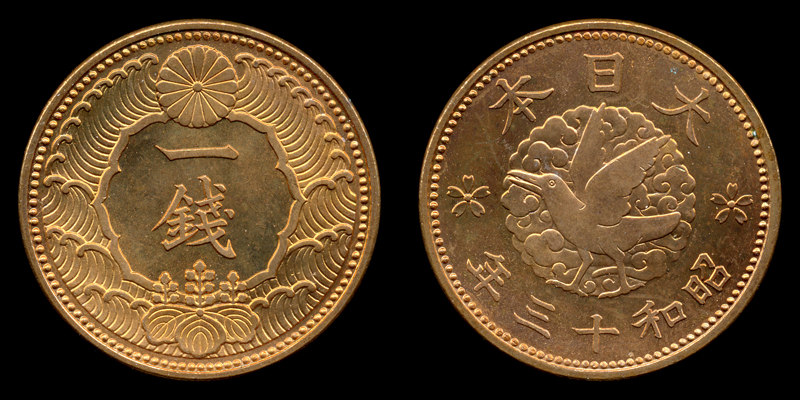
The brass 1938 coin.
In 1938, the Empire of Japan introduced two new coins. The first of these coins was composed of 90% copper and 10% zinc, therefore creating a brass coin. It had a mass of 3.75 grams and a diameter of 23 millimeters, being the same size as the previous coin, but larger than the other 1938 issue. Both coins were designed through a competition held by the Japan Mint. Depicted on the coins’ obverses was the Yatagarasu from Japanese mythology without one of its three legs, and with two cherry blossoms at the sides, the issuing authority above, and the year of minting in Showa below. On the reverses was the value inscribed in the Yata no Kagami. Above the value the Imperial Seal was displayed, while below was the Paulownia Crest. The coin was only minted in 1938, with a total of 113,600,000 coins issued.
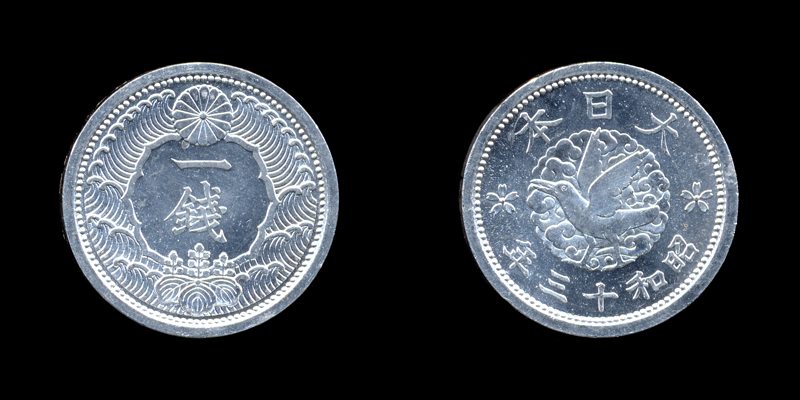
The aluminum 1938 coin.
During the same year, the Empire of Japan had also minted a coin on 100% pure aluminum, due to the need of other metals for weaponry, as Japan had gotten involved in World War II only a year earlier. Unlike the corresponding brass coin, this coin was extremely light, with a mass of 0.9 grams and a diameter of 17.6 millimeters. During 1939 (Showa 4), two different types of these coins, A and B, were minted. The difference between the coins was the way in which the Japanese character for four was written. On type A, the four was written as “四”, but on type B, it was written as ” “. Overall, the aluminum coin was more successful than its brass counterpart, having been used until 1940 due to being made of a more inexpensive and less demanded metal.
1941 issue
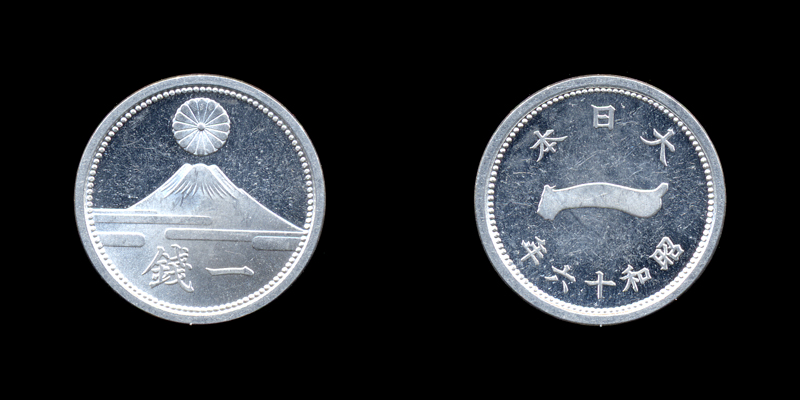
The 1941 issue 1 sen coin.
During 1941, after the short time of minting the previous 1 sen coins, a new issue was produced by the Empire of Japan, which was still a major axis power in World War II. Once again, to lower costs and to save other resources for weaponry, the 1941 coin was composed of aluminum. Because of this, the coin was very light, being only 0.65 grams. It had a diameter of 16 millimeters and a thickness of 1.52 millimeters. Displayed on the coin’s obverse was Mount Fuji, the highest mountain in Japan, with the Imperial Seal above and the value below. Shown on the reverse was the value, issuing authority, and year of minting. These coins were minted up until 1943. In these three years, a total of 2,300,2800,000 of these coins were minted.
Most recent issue
In 1944, the Empire of Japan introduced the most recent 1 sen coin (pictured above). It was composed of tin-zinc, due to the need of other metals for fighting in World War II, just like the use of aluminum in some coins before it. The coin had a mass of 1.3 grams, a diameter of 15 millimeters, and a thickness of 1 millimeter. On this coin’s obverse was the Imperial Seal with the value, with two branches at the side. Displayed on the reverse was the year of minting and the title of the issuing authority. Minting of these coins ended in 1945, and they were demonetized on December 31, 1953.
Clay coin
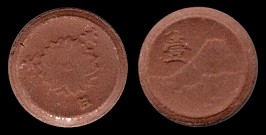
The clay coin from 1945.
In 1945, a new coin was produced. However, it was not minted by the Japan Mint, but by private companies on behalf of the mint. These coins were composed of baked clay. They had a mass of 0.8 grams and a diameter of 15 millimeters. Displayed on the obverse was Mount Fuji and the value (written as 壹), while on the reverse was the Imperial Seal of Japan with the name of the issuing authority. Due to conflicting sources, there is a controversy as to whether or not these coins were ever issued. Some of these sources, such as the Standard Catalog of World Coins, implies that the coins were unofficially used in Central Japan just prior to the end of World War II. However, many other sources contradict this uncommon claim.


