Blog

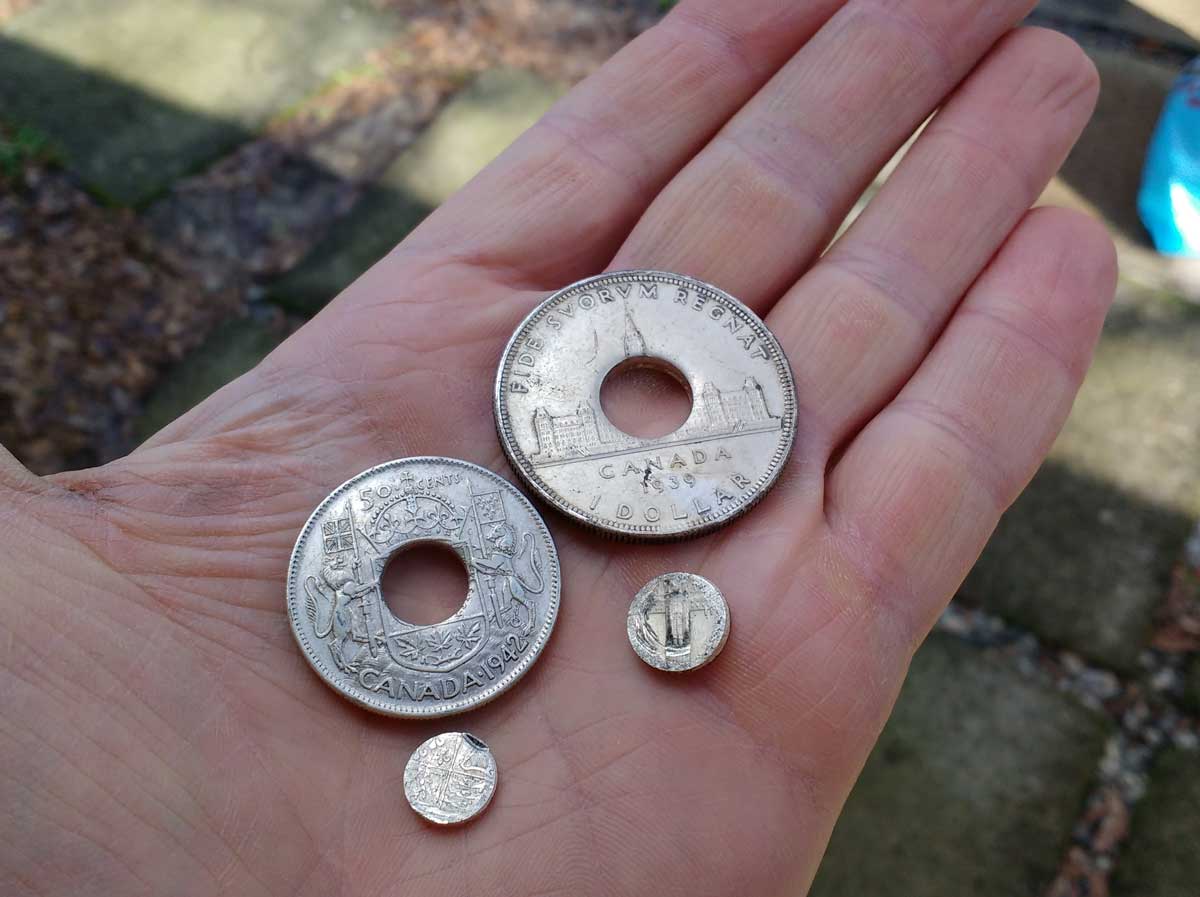
  • 1939 Canadian silver dollar coin ring and 1942 Canadian silver 50 cent coin ring

    1939 Canadian silver dollar coin ring and 1942 Canadian silver 50 cent coin ring

    This set of coin rings is for a very special couple in Canada.  Canadian silver coins can be ringed into very cool looking coin rings.  It was fun crafting both of them.  1939 Canadian silver dollar is around 35mm in diameter and there are 4 different designs.  1942 Canadian 50 cent coin was around 29mm in diameter.

    1939 Canadian silver dollar history

    This coin, the second commemorative silver dollar struck in Canada, was minted to celebrate the visit of King George VI and Queen Elizabeth in 1939. The reverse of the coin depicts the Parliament buildings in Ottawa. The Latin legend FIDE SUORUM REGNAT (He reigns by the faith of his people) appears above. The design was created by sculptor Emmanuel Hahn, whose initials, EH, appeared on the original model. This was not an unusual feature since Hahn’s initials appear on silver dollars minted prior to 1939. His initial H, can also be seen on his well-known designs for Canada’s ten-cent and twenty-five cent pieces – the Bluenose and the caribou head – for the series minted since 1937.

    The Government of the day, however, seemed to disapprove of the personal touch on this coin and the initials were removed from the final version without consultation. Hahn made strong representations to the Mint, the Minister of Finance and the Prime Minister. The only explanation that he received came from W. C. Clark, Deputy Minister of Finance, who informed Hahn that the decision to omit his initials had been made by the Governor in Council. The obverse of the coin bears the portrait of George VI facing left, surrounded by his Latin titles. The coin contains 80% silver.

    1942 Canadian silver 50 cent history

    The fifty-cent piece is the common name of the Canadian coin worth 50 cents. The coin’s reverse depicts the coat of arms of Canada. At the opening ceremonies for the Ottawa branch of the Royal Mint, held on January 2, 1908, Governor General Earl Grey struck the Dominion of Canada’s first domestically produced coin. It was a silver fifty-cent piece bearing the effigy of King Edward VII.

    Mintage

    • 50 cents 1942 – Narrow Date : 1 974 165
    • 50 cents 1942 – Wide Date : Included

    Specifications – 50 cents 1942 – Narrow Date

    • Alloy: 80% silver, 20% copper
    • Weight: 11.66 grams
    • Diameter : 29.72 mm, thickness 2 mm
    • Engraver: Obverse: T. H. Paget, Reverse: G. E. Kruger- Gray
    • Designer: Obverse: T. H. Paget, Reverse: G. E. Kruger- Gray
    • Edge: Reeded
    • Magnetism: Nonmagnetic
    • Die axis: ↑↑
  • Mokume Gane rings – Coin Canival style

    Mokume Gane rings – Coin Canival style

    Mokume Gane rings – Coin Canival style
    I wanted to try this new macro molecular materials (part of the new breed of new age designer materials) for quite sometime now. Finally, I was brave enough to place an order from US. This new metal material is patented and requires a sophisticated lab setup in order to make it. It is also expensive. I have ordered 8 different “flavors” resembling Mokume Gane with wild colours. It is not as easy to work with as I thought it will be but the end result is very unique and appealing ring IMHO.  All the rings I made are super comfortable to wear and they do not leave any dark staining on the skin. They are not very easy to scratch but if you do manage to scratch it it will polish off very easily to the original glossy finish.

    I made 8 different ring samples from each colour mixture. All colours are available in my online shop for custom order as well as I will try to have few samples at the artisan store in Fremantle.

    Macro Molecular Materials are part of the new breed of new age designer materials that make everything from the Stealth Bomber to the International Space Station possible. These materials are made with high purity metals and other exotic elements that have been deconstructed to the macro-molecular level, homogenously combined and then reconstructed with highly refined proprietary chemical binders. Metal deconstruction requires very specialized equipment  Gas Metal Atomizer that super heats the metal and then shoots it with water, gas or plasma causing it to explode into molecules of specific shape and size. Heat, pressure and an exothermic chemical reaction cause the molecules to cross link forming a new material with a unique macro-molecular structure.

    Originally developed for aerospace where the military engineers  uncovered a host of aesthetic qualities that build on the remarkable benefits of these materials. The proprietary process together with the natural interplay of the metals and elements creates exotic metal colors, beautiful random wood grain patterns and metal combinations that were never before possible. Deep, dimensional, mirror finishes with galactic star field qualities make for a surface that is mesmerizing and desirable.

    For example; Macro Molecular Copper is produced by applying the  macro-molecular process to pure copper and producing a completely new form of copper with a unique molecular structure. This new  Copper will literally last forever where regular copper will ultimately oxidize and corrode over time. The new molecular structure allows for an increased strength to weight ratio with enhanced surface characteristics while at the same time being unbelievably easy to turn, cut, shape and polish with standard wood working tools.

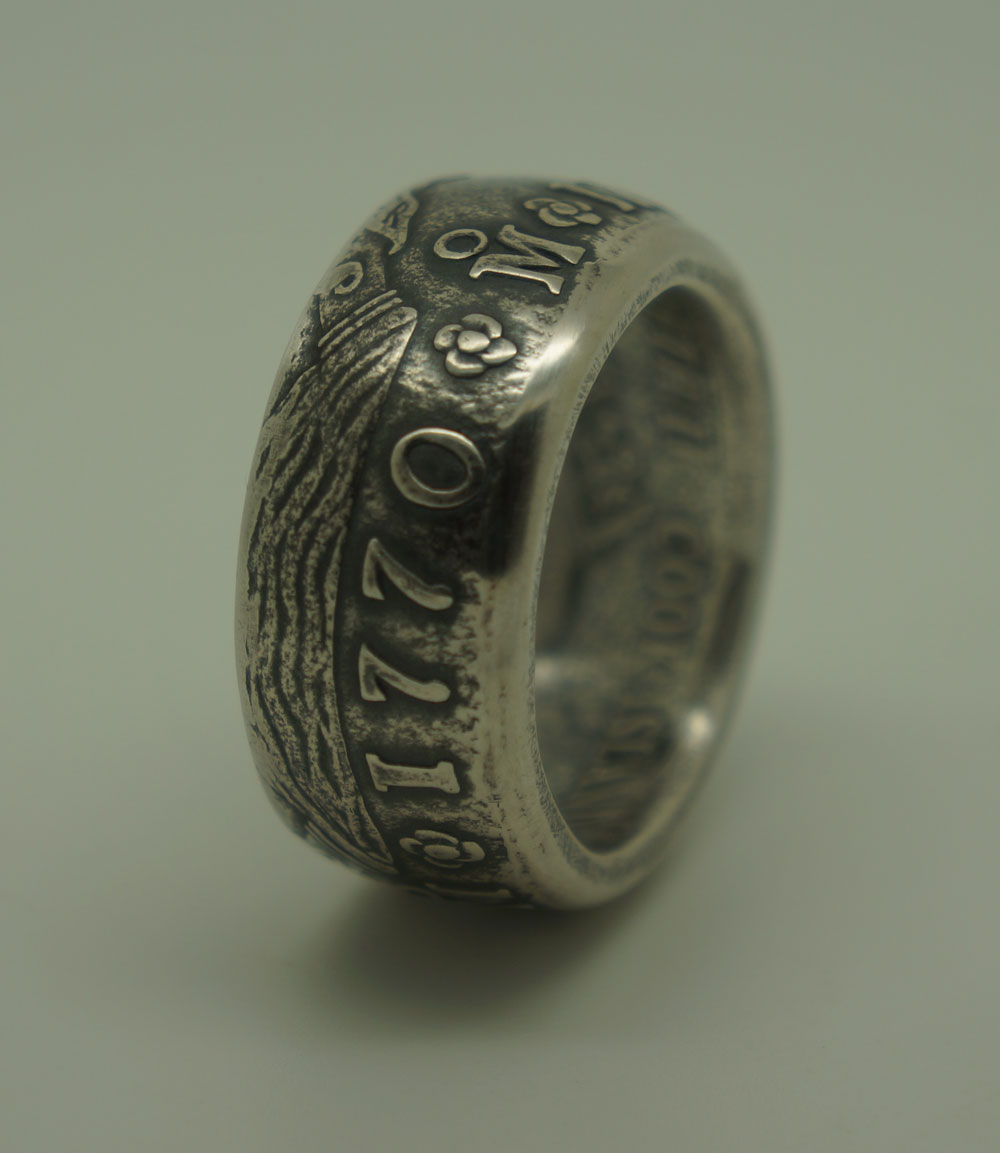
  • 1770 Spanish Colonial English Colony Coin Ring

    1770 Spanish Colonial English Colony Coin Ring

    Early Spanish Colonial coins

    PILLAR DOLLAR
    This is a Spanish 8 reale piece that was the most popular in the American Colonies until 1857. Known as ;Pieces of Eight because of how much the coin could get cut up into pieces to give change.
    The Pillar Dollar was also minted in 4,2, 1 reales. Struck mostly in Mexico Santiago, which was very rare. The obverse has two globes depicting the Old New World. On the reverse the Pillars of Hercules the gates of the New World. Here are some examples of the original coins from 1700’s.

    History
    Spanish colonial coinage in the English colonies

    The importance of Spanish money in the colonies cannot be overstated. It has been estimated that half of the coins in colonial America were Spanish reales. They were used not only as coinage but also treated as a commodity, as one would use silver or gold bars. In 1645 Virginia made the Spanish real the standard currency. In fact, the first coinage authorized by an English Royal patent for the colonies, the American Plantations token, minted at the Tower of London, stated its value on the obverse of the coin not in English currency but as 1/24th of a Spanish real.

    As discussed in the introduction to Massachusetts silver, in 1711, the English ship H.M.S. Feversham requesitioned £569 12s5d in money from the British Treasury Office in New York City before sailing to assist a British fleet for an attack on Quebec. On its way north the ship sank off the coast of Nova Scotia. In 1984 the ship was found and salvaged. Among the items on board were £33 13s in coins, presumably the portion of the allocation obtained in New York. This hoard contained 8 English coins, 22 Dutch coins, 126 pieces of Massachusetts silver, 5 coins from Spain and 504 New World Spanish coins. There is no doubt that even during the period when the Dutch were importing their “Lion Dollars” into New York and most successful local silver coins in the colonies, the Massachusetts Pine Tree series, were still in circulation, the most abundant coinage by far was the silver from colonial Spain.

    In addition to coin hoards there is an abundance of recorded information on Spanish colonial coinage in the English colonies. In 1750 Massachusetts paper currency was redeemed in Spanish silver coin, including many pistareens that had arrived the previous year from England on the ship Mermaid. The ship had delivered 207 chests of milled Spanish pistareens and eight chests of pillar two reales, which the invoice called “pillar pistereens,” along with many British coppers in payment for the colonists’ help against the French during the Louisbourg Expedition in the French and Indian Wars [see, John Sallay in The Colonial Newsletter, 15 (1976) 519-531]. Maryland colonial paper currency issues from 1767-80 were not only backed by Spanish milled coinage but were also denominated in Spanish dollars rather than English pounds, with the $1 and $2 notes of the emissions of Jan. 1, 1767; March 1, 1770, and April 10, 1774, depicting the Spanish milled dollar on the obverse of the note (see our March 1770 examples). In fact, most paper currency issues from the mid 1770’s, including those of the Continental Congress, were made equivalent to and denominated in Spanish dollars.

    As noted above, through the mid Eighteenth century cob coinage continued to be produced throughout the Viceroyalty of Peru, with the final cobs being produced at the Potosí mint in Bolivia in 1773. During this era the English colonists called all cob coinage “Peruvians” and treated them as inferior products. Rather, the colonists avidly sought the “milled” or “pillar dollar” as they called the new eight reales. They referred to smaller denomination coins as “bits” thus the one, two and four reales were the one, two and four bit coins, with the half real called a half bit or a “picayune.” Often the term “bit” was also a graphic description, for the eight reales, or smaller denomination coins, would actually be sawed into halves, quarters or eighths, into actual bits, to make small change. For an interesting discussion of Spanish coins and bits found in Virginia see the Kays article cited in the bibliography.

    Spanish coinage, both cobs and milled products, were treated in a similar fashion throughout the British West Indies. Several islands such as Jamaica, Barbados, Greneda and Montserrat both cut and counterstamped these coins with local marks as a way of producing a regional coinage. Through trade, some of these island counterstamped Spanish pieces made their way into circulation in colonial America.

    Spanish dollars were made legal tender in the United States by an Act of February 9, 1793, and were not demonetized until February 21, 1857. Testaments to the importance of these coins continue in that “two bits,” “pieces of eight” and “picayune” have become part of the American vocabulary. Also, it is interesting to observe that when the New York Stock Exchange opened in 1792 rates were reported in terms of New York shillings which were valued at eight to the Spanish milled dollar, hence changes were reported in eighths. Amazingly, over two hundred years after adoption of the decimal system, stock and security price variations are still reported in eighths!

    Here is my take on this coin … well current commemorative version of this interesting coin: