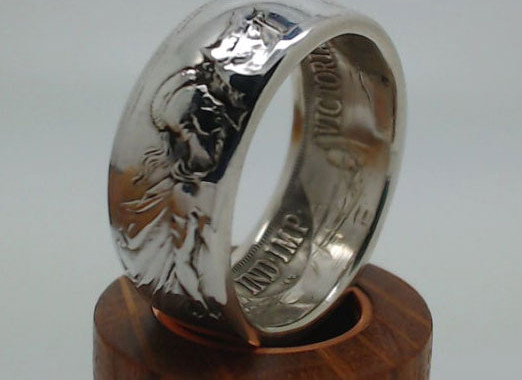
The British crown, the successor to the English crown and the Scottish dollar, came into being with the Union of the kingdoms of England and Scotland in 1707. As with the English coin, its value was five shillings. Always a heavy silver coin weighing about one ounce, during the 19th and 20th centuries the Crown declined from being a real means of exchange to being a coin rarely spent and minted for commemorative purposes only. In that format it has continued to be minted, even following decimalisation of the British currency in 1971. However, as the result of inflation the value of the coin was revised upwards in 1990 to five pounds.
History
The coin’s origins lay in the English silver crown, one of many silver coins that appeared in various countries from the 16th century onwards, the most famous example perhaps being the famous Spanish pieces of eight, all of which were of a similar size and weight (approx 38mm diameter and containing approx 25 grams of fine silver) and thus interchangeable in international trade. The kingdom of England also minted gold Crowns in the 16th and 17th centuries.
The dies for all gold and silver coins of Queen Anne and King George I were engraved by John Croker, a migrant originally from Dresden in the Duchy of Saxony.
The British crown was always a large coin, and from the 19th century it did not circulate well. However, crowns were usually struck in a new monarch’s coronation year, true of each monarch since King George IV up until the present monarch in 1953, with the single exception of King George V.
The Queen Victoria “Gothic” crown of 1847 (with a mintage of just 8,000 and produced to celebrate the Gothic revival) is considered by many to be the most beautiful British coin ever minted.
The King George V “wreath” crowns struck from 1927 through 1936 (excluding 1935 when the more common “rocking horse” crown was minted to commemorate the King’s Silver Jubilee) depict a wreath on the reverse of the coin and were struck in very low numbers. Generally struck late in the year and intended to be purchased as Christmas gifts, they did not circulate well, with the rarest of all dates, 1934 (mintage just 932), now fetching several thousand pounds each. The 1927 “wreath” crowns were struck as proofs only (15,030 minted).
With its large size, many of the later coins were primarily commemoratives. The 1951 issue was for the Festival of Britain, and was only struck in proof condition. The 1965 issue carried the image of Winston Churchill on the reverse, the first time a non-monarch or commoner was ever placed on a British coin, and marked his death. According to the Standard Catalogue of coins, 19,640,000 of this coin were minted, a very high number at the time, making them of little value today except as a mark of respect for the national war leader. Production of the Churchill Crown began on 11 October 1965, and stopped in the summer of 1966.
The crown was worth five shillings (or 60 pre-decimal pence) until decimalisation in February 1971, and was also the basis of other denominations such as the half crown and double crown.
The last five shilling piece was minted in 1965.
The crown coin was nicknamed the dollar, but is not to be confused with the British trade dollar that circulated in the Orient.
In 2014, a new world record price was achieved for a milled silver crown. The coin was issued as a pattern by engraver Thomas Simon in 1663 and nicknamed the “Reddite Crown”. This was presented to Charles II as the new crown piece but was ultimately rejected in favour of the Roettiers Brothers’ design. Auctioneers Spink & Son of London sold the coin on 27 March 2014 for £396,000 including commission.
I have quoted all of the above info from Wikipedia. Very interesting coin with lots of history. Ring made out of this silver crown shown in my photos below was purchased by Keith. Thank you very much for your purchase Keith!